Published by Glen G. Scorgie on 21 Jul 2010

As Theology Totters in the West

Renmin Business Faculty


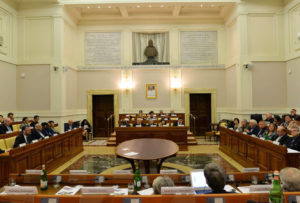
The People’s Republic of China has enthusiastically embraced Western science and technology, and modernity’s materialistic worldview. Pictured above is the imposing business faculty of China’s Renmin (the People’s) University. Here this leading Communist university trains a new generation of Chinese business leaders, offering MBA degrees in global economics along capitalist lines. What you won’t find at the university, however, is a faculty of Christian theology. China is still disdainful of religion, and a robust program in theology would only encourage it. But how different it is in the West, right? Well actually, not so much. Christian theology is in serious decline in the West, even in evangelical seminaries and other institutions of higher learning. Pretty soon it may be on life support here as well.


There is a reason why theology is atrophying in the West. There’s more to it than America’s growing appetite for the likes of Jerry Springer and other coarsening influences.


About a thousand years ago the great medieval theologian Thomas Aquinas tried to harmonize the philosophical wisdom of Aristotle and the revealed truths of his Christian faith. For him, Nature or general revelation (studied in philosophy and science) served as the platform of knowledge, and “Grace” or special revelation (embodied chiefly in Scripture, and studied in theology or divinity) was added to provide what nature was incapable of delivering, due to its intrinsic limits and the fallibility of the human mind to process its latent potential.


This was a useful distinction, and one that came to be reflected in the structure of the earliest university faculties and curricula. What divinity lacked in its relative breadth, vis a vis philosophy and science, it made up for by the unique and crucial knowledge it delivered about God and the plan of human salvation. Eventually both Roman Catholic and Protestant education came around to adopting this basic division, as reflected in the modern tradition of a humanities and science undergraduate degree, upon which theology or divinity was added as a graduate level capstone at the Divinity School.


If anything, Protestants have given even higher priority than Roman Catholics have to special revelation. Instead of special revelation arriving to fill in the gaps in Nature’s witness, special revelation provides for many Protestants the centering themes and understandings that philosophy and science subsequently develop and flesh out. Thus special revelation, rather than being an add-on at the end, necessary but still rather like an appendix, becomes the orienting framework for everything else. Architecturally, that’s why you tend to find the chapel at the heart of the older Protestant university campuses. And that’s why we still have divinity schools at places like Harvard, Yale, Duke and the University of Chicago.


But then came pragmatism—America’s specialty. I don’t want to read too much into mere titles of institutions, but at one time the term “divinity school” conveyed in an intentional way an institution’s commitment to specializing in the study and transmission of the legacy of special revelation. The closely cognate term “seminary” has a more professional and vocational focus—an institution for the training and formation of clergy. St. Mary’s College, where I studied at St. Andrews, has been known since 1411 as the divinity school within the larger university, and I am pretty sure it would be loathe to change its name to seminary, for the reason mentioned above. I suspect that at the seminary where I teach (and where we dropped the adjective “theological” a while ago) we now have a predominantly professional vision of our institutional mission, and in light of that it is debatable whether divinity is still as strong a collective focus. The name we have adopted and the way we operate would suggest that we really are what we call ourselves, a seminary—a professional school in which it is no longer justifiable to regard the study of divinity (the specially revealed things of God) as our primary focus.


Instead a “well-rounded” training curriculum should include doses of various disciplines among which divinity would be just one among others—like psychology, cultural anthropology, management theory, etc. What tends to unite the various disciplines in the curriculum is the faculty’s shared commitment to producing a competent and “together” professional minister. For all intents and purposes, I think this is what most American seminaries have become or will soon be.


With new, ever shorter and more pragmatic curricula being considered, for marketing and recruitment reasons, by accredited seminaries throughout North America, it remains to be seen what the future of theology or divinity will be. The growing consensus among number-crunching administrators is that an introductory (and quasi-catechetical) survey of doctrine will remain important to the preparation of ministers, but beyond such a minimalist baseline anything deeper is strictly optional. Already theological libraries lie largely idle as seminary students are rarely expected to probe deeper than the contents of their survey course textbooks. Today one is more likely to have an informed conversation about Paul Tillich, Immanuel Kant or even Thomas Torrance in a secular Chinese university than in an American evangelical seminary.


If our new schools no longer have time for lively, substantive theological reflection, where will these vital conversations take place? From where will the truly prophetic and culturally relevant voices come? Will there be any home left for theology, or will it become an orphan discipline in the West, as it now is under Communism in the East? It is a great irony, but perhaps the very thing that ideological opponents of Christianity in Asia are seeking to achieve through the suppression of a discipline is being quietly and effectively accomplished in the West by surrender to market forces and evangelical indifference to the life of the mind.


Published by Glen G. Scorgie on 28 Jun 2010

The Future of Smoke Stacks


Beijing Smoke Stack


Beijing is a polluted city. Not even the spin-doctors deny that the air here is bad. On a windy day you can taste it. But upon my arrival it still came as a surprise to see a huge ten-storey industrial smoke stack right across the street from my apartment on the campus of Renmin (the People’s) University. Encased in scaffolding, workers have been banging and jack hammering on it every day. The project’s location struck me as particularly offensive—way too close to this residential university, an inappropriate site in an already-dense urban environment. And then eight weeks on I made a surprising discovery. The smoke stack is not going up; it’s actually coming down! It’s another sign that China is making a serious effort to go “green.”

Continue Reading »

Published by Glen G. Scorgie on 19 Jun 2010

Quanxi and the Image of God


China


Yesterday I had the unusual privilege of attending a business management conference in Shanghai. It was sponsored by the Euro-China Centre for Leadership and Responsibility (ECCLAR), and its purpose was to explore the “Practical Wisdom for Management” present in the Chinese classical traditions—especially Confucianism, Daoism and Buddhism. A speaker said something that got me thinking about a conversation I had years ago with one of my young (at the time) daughters about the pros and cons of killing a dog. I should probably explain.

Continue Reading »

Published by Glen G. Scorgie on 06 Jun 2010

The Canary in the Gulf of Mexico


China Recycling


At the moment the world is fixated on the video-cam of oil spewing up out of the earth to defile the Gulf of Mexico. Everyone is hoping and praying that a technical solution will be found to stabilize this environmental holocaust. Should this occur in the near future, we will breathe a collective sigh of relief. Inevitably there will be resolutions to tighten up oil drilling safety standards and improve emergency response strategies, but perhaps the greater tragedy will be if in a few weeks or months we resume our same dangerous and unsustainable way of life. If this disaster proves to be of sufficient magnitude that it will not be possible thereafter to revert to business as usual, the tragedy itself may end up a “severe mercy.” We may look back on it as the moment when “the canary died in the coal mine.” It may be our chance to break out of something that is otherwise going to kill us all.

Continue Reading »

Published by Glen G. Scorgie on 05 Jun 2010

Please, Help Me!

 Taoism


One of the near-universal functions of religion is to solicit help from the Higher Power to meet our needs. The main function of prayer, it seems, is petition—asking, begging, making promises and cutting deals, in order (we hope) to get stuff. I saw this dynamic alive and well at the White Cloud Taoist Temple I visited in a slightly scruffier part of Beijing. People kept arriving with gifts of fruit and flowers for the various deities (idols), and lighting incense sticks before kneeling before the images to ask for favors. It got me wondering how the prayers that Christians tend to ask are really much different.

Continue Reading »

Published by Glen G. Scorgie on 25 May 2010

Religion as Therapy in China

Lama Temple Beijing


I have been in Beijing, China for about three weeks now as a visiting scholar at Renmin (the People’s) University, founded by Chairman Mao, and at the Chinese Academy of Social Sciences. I am comfortably housed in the Foreign Expert Building on the University campus, and get to bike around the leafy campus alongside many of future leaders of the Communist Party and of China itself. Without denying the real differences between West and East, it’s surprising how much is the same, even in the sphere of religion.

Continue Reading »

Published by Glen G. Scorgie on 19 Apr 2010

The Rest of the Story

This past week the Los Angeles Times ran a brief obituary of the distinguished English scholar Antony Flew (1923-2010). Flew was a high-profile academic philosopher noted, even among impressive peers, as an exceptional intellect. After service in the Royal Air Force during World War II, he studied at Oxford and there participated in weekly meetings originally organized by C. S. Lewis. The author or co-author of more than thirty books, he is best known for his rigorously logical arguments against the existence of God.

However, this champion of atheism began to waver in his convictions later in life. The possibility that the planet’s delicate ecosystem might be the product of mere chance seemed increasingly improbable to him, and in the end, and without any intellectual slippage, he had crossed over to the other side of the divide over God.

His brief obituary also mentioned that he was the son of a Methodist minister, and as a teenager had abandoned belief in God after wrestling with the problem of evil. Flew’s father died years before his son saw the light, and never lived to see the unlikely turnaround in his brilliant sons’ heart and mind. It’s a reminder that everyone is on a lifelong journey, and it’s never over ’til it’s over. Sometimes waiting fathers and mothers, and other loved ones, may even dare, like Abraham and Moses and a host of other saints, to die in hope. We may not always get to see the rest of the story.

Published by Glen G. Scorgie on 18 Jan 2010

“Big Mac” and Compunction


In a televised interview this past week Mark McGuire (Big Mac), one of major league baseball’s greatest home run hitters ever, admitted something he’s never been willing to admit before, even during a United States congressional hearing. He finally conceded that during the time he was setting all his hitting records as a St. Louis Cardinals he was also using steroids—a substance banned by the league and dangerous to any user’s long-term health. Yet his “confession” felt deeply unsatisfying to most people who watched it; the missing ingredient was compunction.

Continue Reading »

Published by Glen G. Scorgie on 28 Sep 2009

Is the War in Afghanistan a Just War?


Last week a friend phoned me to describe a bumper sticker she had noticed on a car in the parking lot of a local mall. Playing off a familiar query, it posed this question: “What would Jesus bomb?” It’s a disturbing question because few of us can imagine the Jesus who blessed little children, and chose for himself to absorb violence rather than dish it out, would ever give a thumbs-up to fully armed commandos in camouflage. But it’s also in some ways an irritating question, because it does not seem to acknowledge the complexities of living in a fallen world.

Continue Reading »

Published by Glen G. Scorgie on 23 Aug 2009

A Russian View of Sexuality


Last week we set off for a brief vacation up at Yosemite in California’s Sierra mountain range. On the way up, in the wickedly hot central valley around Fresno, we stopped into a Borders bookstore for some light reading material, and I came across what looked like an interesting collection of short stories. Even better, the volume was on sale that day. But I wasn’t prepared for what it contained.

Continue Reading »

Next »