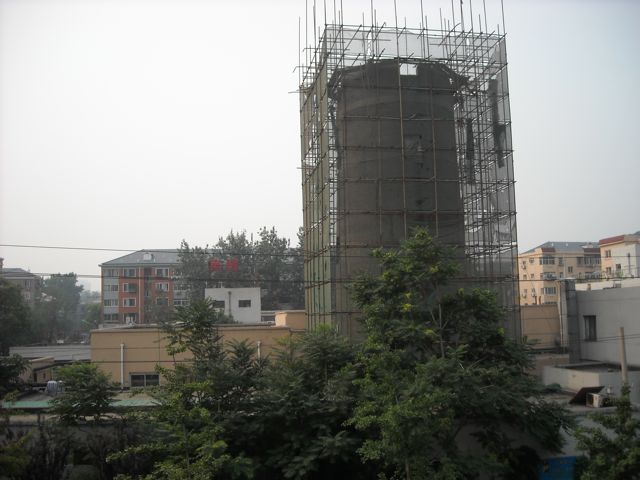
Beijing is a polluted city. Not even the spin-doctors deny that the air here is bad. On a windy day you can taste it. But upon my arrival it still came as a surprise to see a huge ten-storey industrial smoke stack right across the street from my apartment on the campus of Renmin (the People’s) University. Encased in scaffolding, workers have been banging and jack hammering on it every day. The project’s location struck me as particularly offensive—way too close to this residential university, an inappropriate site in an already-dense urban environment. And then eight weeks on I made a surprising discovery. The smoke stack is not going up; it’s actually coming down! It’s another sign that China is making a serious effort to go “green.”
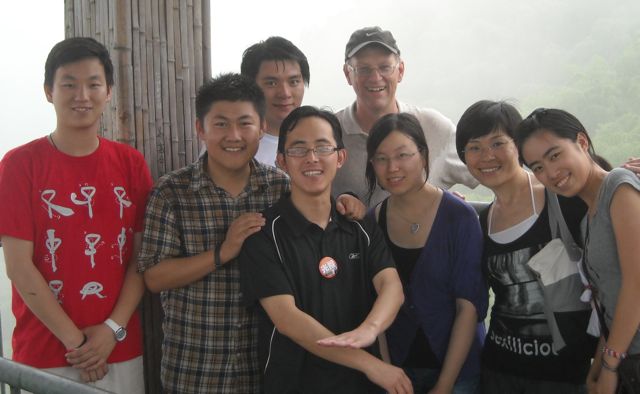
Yesterday I had the unusual privilege of attending a business management conference in Shanghai. It was sponsored by the Euro-China Centre for Leadership and Responsibility (ECCLAR), and its purpose was to explore the “Practical Wisdom for Management” present in the Chinese classical traditions—especially Confucianism, Daoism and Buddhism. A speaker said something that got me thinking about a conversation I had years ago with one of my young (at the time) daughters about the pros and cons of killing a dog. I should probably explain.
At the moment the world is fixated on the video-cam of oil spewing up out of the earth to defile the Gulf of Mexico. Everyone is hoping and praying that a technical solution will be found to stabilize this environmental holocaust. Should this occur in the near future, we will breathe a collective sigh of relief. Inevitably there will be resolutions to tighten up oil drilling safety standards and improve emergency response strategies, but perhaps the greater tragedy will be if in a few weeks or months we resume our same dangerous and unsustainable way of life. If this disaster proves to be of sufficient magnitude that it will not be possible thereafter to revert to business as usual, the tragedy itself may end up a “severe mercy.” We may look back on it as the moment when “the canary died in the coal mine.” It may be our chance to break out of something that is otherwise going to kill us all.
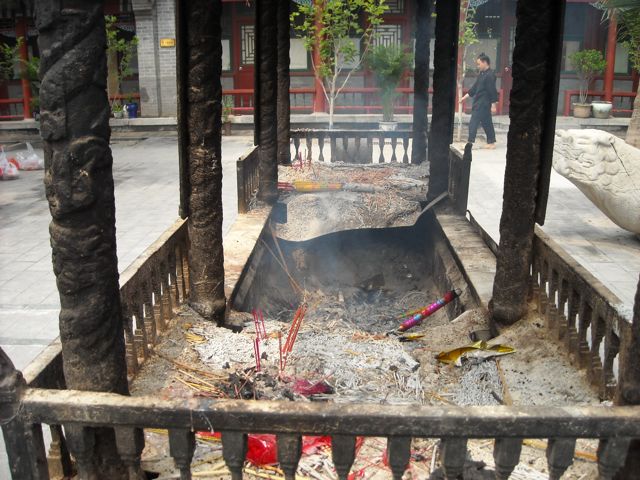
One of the near-universal functions of religion is to solicit help from the Higher Power to meet our needs. The main function of prayer, it seems, is petition—asking, begging, making promises and cutting deals, in order (we hope) to get stuff. I saw this dynamic alive and well at the White Cloud Taoist Temple I visited in a slightly scruffier part of Beijing. People kept arriving with gifts of fruit and flowers for the various deities (idols), and lighting incense sticks before kneeling before the images to ask for favors. It got me wondering how the prayers that Christians tend to ask are really much different.
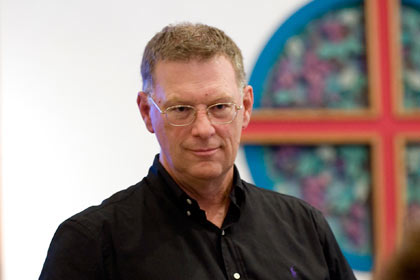
Scorgie, a Canadian, has been professor of theology at Bethel Seminary San Diego since 1996. He is also involved in the Chinese Bible Church of San Diego and lectures regularly in Asia.